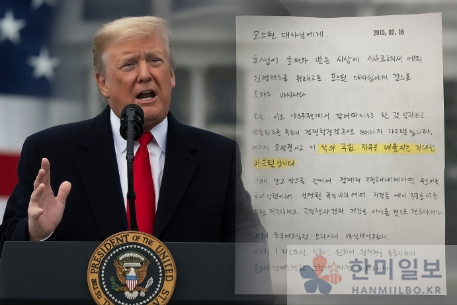
The War in Washington and the Awakening in Seoul
Two words have shaken the world order in the 21st century: globalism and political correctness. The great movement toward integration beyond borders and cultures appeared, at first, as progress for humanity. Yet behind it, national sovereignty and freedom were slowly eroded. Freedom of expression was curbed in the name of political correctness, while elections and institutions fell prey to invisible forces(the deep state). Both the United States and South Korea have lived through this erosion of democratic foundations.
Today, President Donald Trump in Washington and former President Yoon Suk-yeol in a prison cell in Seoul are asking the same question:
“How do we break the chains of globalism and the deep state that strangle democracy?”
Trump’s declaration of a de facto state of emergency in Washington D.C. was not simply a law-and-order measure. It was a war of liberation against the globalists and the deep state entrenched in the capital. Washington is not merely an administrative hub. It is the nerve center of networks in finance, media, law, and politics through which globalism reproduces its power. By striking at this core, Trump sought to restore the essence of democracy: the rule of law and order.
Aligned with globalist interests, old media claimed that “Washington’s crime rate has fallen to historic lows.” But this was a distorted narrative. In 2023, Washington D.C.’s homicide rate stood at 40.9 per 100,000—far higher than Mexico City (approx. 8–10) or Bogotá (approx. 15.6). Even after falling to 27.3 in 2024, the city would still have ranked among the most violent in the United States if treated as a state. These figures were not mere statistics; they reflected institutional breakdown and the collapse of community trust. What Trump targeted through his emergency measures was precisely this parasitic structure of the deep state.
South Korea is not immune. During his presidency, Yoon failed to grasp the full extent of globalism’s destructive force. But in his prison letter to former U.S. Ambassador-at-Large Morse Tan, he described globalism as “a vast cartel that buries the nation, sovereignty, and freedom.” His words about a “cartel of vested interests” mirror what we now commonly call the deep state. The awakening came late, but its meaning is profound. South Korea today faces electoral distrust and entrenched deep-state structures—signs of democracy in decay. The parallel with Trump’s own confrontation during the 2020 U.S. election is unmistakable.
Overlapping this picture is the role of China, the greatest beneficiary of globalism. Through manufacturing, technology, and exports, China has amassed enormous wealth and influence. Yet this was not the product of fair competition. It was the outcome of a globalist and deep-state order that permitted unequal prosperity. Trump’s trade war with China and Yoon’s belated denunciation of globalism point to the same global front.
The Korea–U.S. alliance today can no longer be explained only in terms of military or economic logic. It has become a value alliance shaped by two leaders’ awakenings in the face of historic challenges. President Trump declared war on globalism and the deep state from the heart of Washington, while former President Yoon Suk-yeol confronted the same reality from a prison cell. Their paths diverged, but they converged on the same destination: to defend sovereignty, restore fair elections, and revive the rule of law as the bedrock of democracy.
Trump’s call for “modernizing alliances” must be understood in this context. It is not about budgets or bases. It is about rebuilding alliances as value alliances—against globalism, the deep state, political correctness, and fraudulent elections. Washington’s emergency declaration and Seoul’s prison letter, though vastly different in form, ask the same question:
“Whose democracy is this, and who will defend it?”
If Trump turns his back on Yoon, he will lose more than one man. He will forfeit a comrade on the frontline of East Asia. But if he embraces Yoon’s awakening as part of a renewed value alliance, the United States and South Korea can stand as two pillars of a global front against globalism and the deep state. The war of liberation that began in Washington could extend to Seoul and across Asia, shaping a new narrative for the free world in the 21st century.
#Trump #YoonSukYeol #AllianceModernization #ValueAlliance #Globalism #DeepState #ElectionFraud #OldMedia #RuleOfLaw #FreedomAndDemocracy




 [특별기획: 조우석] ②대통령병 환자 홍석현, 탐욕의 30년을 아세요?
 美 "미군 2명 전사·1명 실종"…이란 직접 공격에 첫 사망
 김정은, 왕후닝 접견…"북중조약 입각한 관계발전방침 확고부동"<연합뉴스>
 아들 특혜채용 전 선관위 사무총장 김세현 징역 2년… "공정 원칙 훼손"
 [초점] 한은, 외생위험 커졌는데 금리 올렸다… “정치인가 정책인가”
 [신간] 5표를 얻기 위해 1표를 버린 결과는?… 황승연 ‘상속세와 대한민국의 운명’
 [포토] 열대야 "너무 덥다"… 강변으로 바닷가로
 [영상] 美 건국 250주년 에어쇼... 뉴욕 하늘 가로지른 ‘창공의 예술’
 [김성민 칼럼] 유리한 결과만 골라 실은 5·18진상규명위 보고서
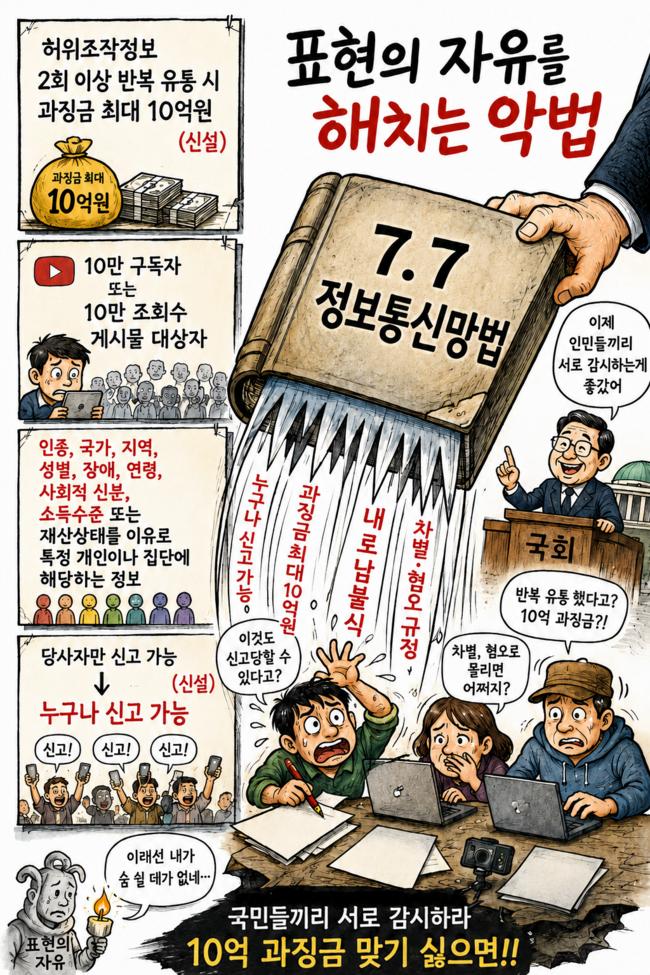 [시사만화] 표현의 자유를 해치는 악법
 목록
목록